Showing posts with label history. Show all posts

Aug 30, 2008

Real unity of Taiwan and China

Brand new Taiwan? or Brand new dependence?

Taiwan today is running forward to the new aspect of political argument between big continent and small islands. However, merchandisers keep on producing attractive goods for ordinary potential customers who come from each sides. They are supposed to be the winner of the argument in terms of economy. Everybody would agree it is the point that distinguish Chinese people from other ethnicity. Money is the matter.

They(sellers) tried to confirm those fancy stuffs are very famous to young people in Taiwan. Well, did I hear about that? Or haven't seen it before on the street? I don't care. In fact, they don't care neither. They sell, I buy.


Andy, and Marylin, I'm sorry for that.


Is this co-existence chemical or economic?


It looks 'not bad' if we gaze at it far from the display.


Do you want to rule Formosa again? No way.


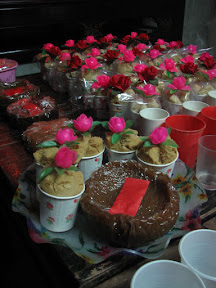
Communist-colored Jang. How is the taste of coffee inside?

From 桃園


Above all these mentions, I bought this there, unfortunately. Don't say anything about this consumption. It was just a trade, money and goods, capitalism. In a rainy day, I visited the graves of two Jang's at Taouen, surrounded by huge lake and a park with many serious sculptures of himself.

Jun 21, 2008

Rodui and Neipu in Southern Taiwan

Several months ago, I went a village, Neipu內埔. It is near Pingdong, a big city in Southern Taiwan, where some of my friends live. Around that city area is usually known as the place for aboriginal tribes, such as Tsou, Paiwan, and Rukai. Many of my aboriginal friends are also from Pindong. One of the famous places near that city is Sandimen山地門.


There are also large area for Hakka(their own pronunciation) people. Also known as Kejia(Mandarin), but the writing is same as "客家", originated from Guangdong廣東, or more North of China according to the history.


Their population is not more than 20% and have settled all across Taiwan. Some villages are famous place for tourism by their special culture and architectures as well as food.


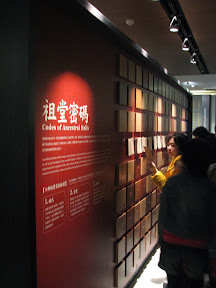
This is their pedigree. I found it at a Hakka cultural center in RoDui(六堆), also locates nearby Pindong and Neipu. Each card shows one family name, and the seeking the root of their blood. Although there are lots of fascinating things and performances, this room was mostly impressive to me. As I know about their great historical endeavor for "loyalty" and "education," Hakka people's achievements and highly recommended culture can be admired enough. It's one of the precious resources of Taiwan.


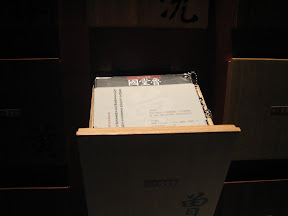
One big bookshelf contains many small drawers, and each drawer has each family name, such as 楊, 林, and 酨. The card provide possible history and genesis of family names of Hakka people that speaks their long and hard struggle to settle not only this island but also Guandong and Fuzien, old and far more.

From RoDui(六堆) Hak...

May 2, 2008

Maju媽祖 of Luerhman鹿耳門

Believing something or someone is mostly the matter of psychology. Trust is obtained and supported by experience, knowledge, and common sense. Faith or belief among people is formed with personal relationship and experience either. If we see some similar and common phenomena in many other people, we might not say it's a sort of psychology.

Without study of anthropologists, we know religious belief and faith are real in people's mind. Sometimes it's rapid fashion, sometimes habit and culture inherited for many years. And they are inseparable. Therefore, religion, culture, habit, custom and social engagements are all not only mental but also material factor.

From 鹿耳門天后宮


Maju媽祖 is one of the highest god in Taiwan, who originally came from South-eastern coast of China, the province of 福建Fuzen. Since they had departed to cross the Taiwan strait 400 years ago, they have believed this female god would protect their sailing. Now it is honored and believed by many Taiwanese as their own god who not only cares ship sailing but also other matters of entire human life. It was just a simple god for safe sailing but now became a great god who manages life and health, economy, business. Some part of liturgy is still related to their first place. But it seems to be regarded as different god now.


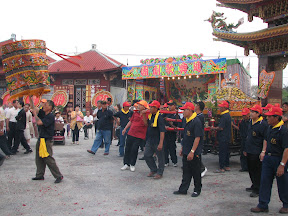
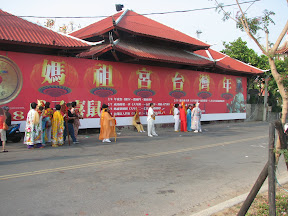
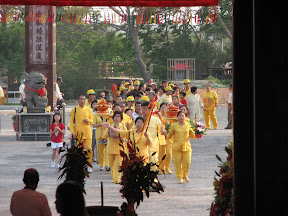
There are many branch temples in Taiwan such as Anping, Kaohsiung, and Pingdong. The temples send their representing performance team at common ceremony day as this day. They wear different uniforms, caps, and prepared special ceremonies one another. For example, a team performed a Tzgong and monks dancing, one brought a sedan as the vehicle of their god, one came with women who wear Qing dynasty's costume, the other spreaded a lot of crackers on the ground and sky.


Drums, singing, chanting scripture, playing puppet show, declaring liturgy order, exploding fire crackers, burning paper money, offering incenses, praying, eating, smoking, talking, etc... So many people gathered from all across the country when I visited there. And I was excited too.

From 鹿耳門天后宮


This temple is another landmark of Taiwan to me. And faith of Maju is much interesting phenomena to think much more from now on. I hope I can visit there again.

Apr 23, 2008

Traces of "first" Christianity in Taiwan

I visited Changrong senior high school on Monday. There is an interesting museum of school's history as well as many national treasures (I believe) of Taiwan. For example, I found the first printer of this country which had used in this school for Christian missionary work.

This school was one of the first modern educational institution in Taiwan established in late 19th century. Some missionaries from Western Churches had devoted their lives to the mission in this country. It was 1860s here and not so earlier than when the first missionaries came to Korea too.

From 長榮高中


The earlier missionaries had made great efforts to help local context even though historically many of them were reported and blamed their (un)conscious leading of imperialism to Asia and Africa. They not only established hospitals and schools, but also devoted themselves to help people in fact.

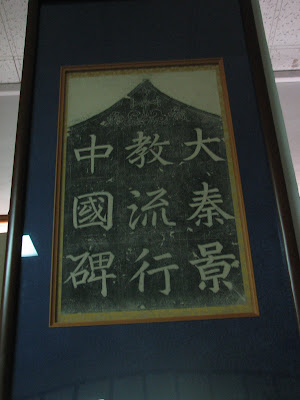
The other exciting thing was a real rubbing copy拓本 of 大秦景?流行中國碑. Let me explain what it is shortly. That is a stone monument established in C.E.781 at Changan長安(Now it is called as 西安), the capital of Tang dynasty. It indicates that one of the earliest sect of Christanity has arrived to China at least 8th century. Historically, it is so important that I was really excited to find out the copy there. The title could be translated ruffly as "monument of the spread roman Chrisanity in China"(actually the bearers of Christianity were Nestorian missionaries, accused and executed as an heretic by Western Catholic in Rome).

From 長榮高中


One of the first three missionaries in Taiwan also had those sort of conviction and came to Taiwan as well as Korea. In result, I became a Christian after 100 years. Well, I have read many books about history and interpretations about the arrival of Christianity in Asian countries. I need to feel and get to know much more about what really brought the missionaries to unknown and 'dangerous' places, and what really made Asian people, just like my ancestors, converted their faith.

Dec 29, 2007

Hakka in Taiwan

Someone asked me about Hakka in Taiwan. He(I guess) became to be interested in history of Hakka when reading a post on my another blog written in Korean language. I wonder the person has understanding of history of Taiwan or ethnic background. But I believe it's good for any foreigner to get to know more about this country.

I depict Hakka people as gypsy to explain easier. Indeed they are talented to artwork, music, poem, and so on. Even though they often has been excluded and shunned historically, they survived here and all around the Asia even Korea, Myanmar as well as Malaysia or Singapore.

They believe their ancestors are from north part of China and gradually has come down to southeastern provinces. Those in Taiwan also had crossed to island of Taiwan through hundreds of years. Their population is now approximately 20 percent.

As I blogged there, I was emotionally and really shocked by their history which recovered by great efforts of Hakka historians and artists. Their history was the history of blood as it was. They were attacked and boycotted whenever they tried to settle down near Han people's place so that another struggle, sometimes bloody combat, flight and wandering was waiting again.

So it's one more part of Taiwan history I've learned. There are much more complicated factors of social conflict in Taiwan as other countries. Among the them, except the relation with China, matter of ethnicity seems to be tough issue today.